Easy Walker shoes

Easy Walker website

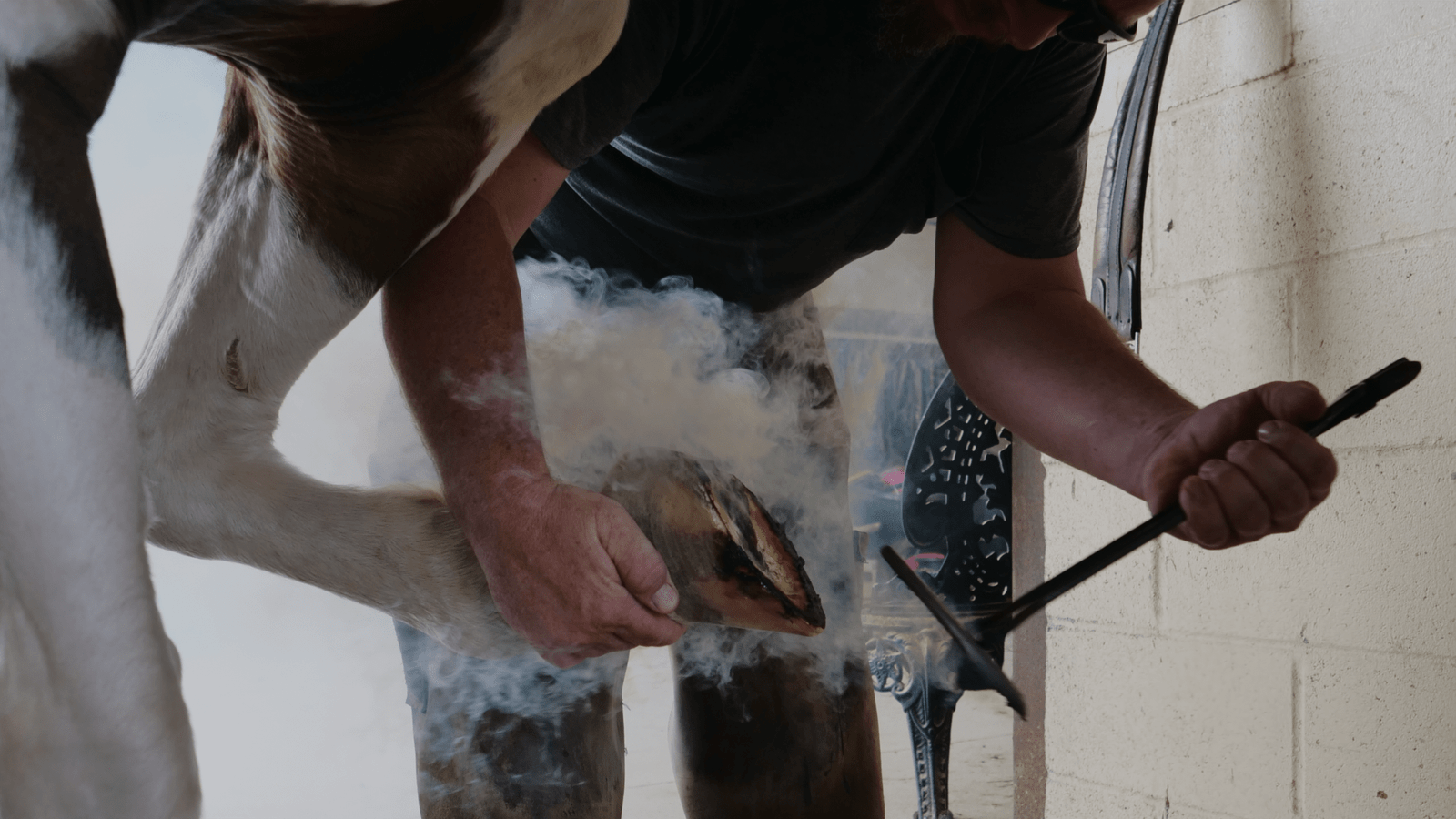
Using these shoes is something new for me. They are supposed to reduce concussion more than steel and flex with the hoof. The owner is a former “barefoot” person and her horse wouldn’t stay sound. She tried various hoof boots; tired of that, wanted to try these.

The owner says the horse is moving better than ever with these shoes. She trail rides in fairly rough terrain and also says that the horse’s stability and comfort on the trail is excellent.

They are certainly worn out and not able to reset. If you look closely and the toe, you can see how much wear there is. They don’t wear as well as steel shoes, but they do work.

They are pretty neat, but the problem I have with them is the punching for the nails. Traditional shoeing leaves the nail heads just above the surface of the shoe. That provides stability that the nails don’t become loose prematurely. Also, if a nail needs to be re-driven, traditional crease nail pullers don’t work with these shoes.

All-in-all, I like them, and I think they have their use, but they are not perfect.

TSE/Tattersalls announces final sale

Their website.

Another local signature equestrian legacy ends in 2011. They have a reputation that will be hard to match, and we will miss all that they brought to the Lexington, KY area.

My 3D studies bring me to be reading Euler.

I’m going through the Blender 3D software course and Leonhard Euler (pronounced “Oiler”) 15 April 1707 – 18 September 1783, came up.

He had 13 children, and only 5 survived. Often, it seems, the gifted pay heartily. The wikipedia article is a fascinating read.

He introduced much of the modern mathematical terminology and notation, particularly for mathematical analysis, such as the notion of a mathematical function. He is also renowned for his work in mechanics, fluid dynamics, optics, and astronomy.

European political implications had fascinating effects on this man and the science from him. I’m glad I live in American now, but we should learn some lessons from this man’s history.

Cameron Knight’s Lubitel Tutorial

I keep seeing “scott gregory farrier” being searched on google analytics, so I thought I’d see what they might be finding. Not much really, but this was neat.

I remember when Cameron Knight came out to Chili’s to shoot for his article. Amazingly, he got a shot he liked. All I remember is how wretchedly hot it was and I could barely stand up because I was going through a back problem. I just couldn’t manage anything better than a grimmace.

The article is a good read.

Technology can be a drag when it isn’t working.

I’m re-installing stuff on my 2nd replacement phone -again-. I have to say that Sprint always takes care of me, but I hope I’m done running to the store and dealing with this.

I use it as a pocket laptop, so it is very disruptive when it isn’t working, and it takes quite a bit of time to set it all back up the way I like it, and this is the third time. On that note, though, I was also having trouble with poor signal quality at home, so they sent us this AirRave device that connects to our broadband router and presto! it’s a full signal.

I’m thankful to be back up and running, and even better than before. If I get another 18 months or so of trouble free communications like last time, then I guess I can’t complain.

Tiny trim’n

Young mini donkey hoof


Trim’n some hooves.


The new way

All-right clients – this is how I want your horses to behave.

Well…

First, the bull tried to hump the donkey I was working on, and then, the Rottweiler bit me. Not bad or anything; but still. Glad to be back at the desktop again.

travel’n shoe repair

Started the day in Felicity with some excellent clients of at least 15 years. Then to Lebanon, to Wilmington (almost anyway) for 2 lost shoes. Good thing I love my clients and their horses.

All sorts of different stuff today.

The remaining agenda: A “Z bar” shoe for a re-sected heel, Easywalkers for a barefoot convert, an advanced laminitis case, and a head bobber to hopefully figure out.

Fall theme

All the talk these days is about body clips, blankets, and pulling shoes for the winter. I ordered my snow pads and equithane to keep the ones still in shoes safer in the snow.

October rain…

he's out there.

Now this…

The last horse of the day came in from the field soaking wet and shaking. Yuck.

Tom Hill, horseshoe sculptor

This is some truly amazing work. Website.

Shoeing the eventer hind.

Shoeing an eventer with proper hind traction package


Using Kerckhaert sx8 hinds, this horse is all set up to work on the roads with those drive in studs or on the grass using the drilled and tapped holes to place caulks. I know it seems that I have trailers on all my hinds if you look around at this site, but I swear it is not true. This one has them because he is very narrow behind and this set up has allowed him more ease of collection. They have not seemed to be a hindrance on the cross country course either as we considered they might be.

You may notice the balance of this shoe is shifted slightly to the outside. This is because this horse has a minor deviation of the pastern (particularly on the right hind) and needs some lateral support.

lateral trailers


Monday

Some webwork this am to start it off,

Tractor Supply for chicken feed,

**Inventory!!** Including some forging and grinding so I don’t have to do as much of it at your barn,

chicken coop cleaning, mowing, & some equipment maintenance (4 wheeler, chainsaw, and bushhog at the moment)…

oh, and emails, billing, & scheduling.

Hopefully, as usual, that will get us to next Monday again. Contrary to the sounds of the general population, I love Mondays. Mondays allow me to love the rest of the week.

Forging…

Handmades are simply the best... when necessary.


Ready to go again & thankful.

Back to my regularly scheduled Monday program of scheduling, billing, inventory, and maintenance with a little bit of makeup thrown in. Oh, yeah; and mowing?

It has been a long time since I have been sick.

Blah. I don’t love it. All is canceled for a day or two. Maybe some web work. Maybe.

If so, I need to go through my seemingly endless shoeing files (and others) and clean them up. Very time consuming and mostly mundane, therefore a good project for being sick.

On a similar note, I have been playing with virtual machines. Since I had to rebuild my system and it can now easily handle a dozen or so extra operating systems, I now see how well they play on a virtual-ized network. I can build all the sites and systems I want while working on a solid desk top environment like Mint. It’s easy.

Virtual machine Archlinux install with wiki at the ready.


This server is going to manage backups and versions.

Shoe board updated

link

I’m a geek too

Just so you know, I can build and fix computers as well as operating systems, networks and websites. I have always had a secondary interest and sort of an “insurance” occupation, and I build quality stuff. It’s my only known solution to this winter problem I always have.

Stable Scoop Radio Show

I’ve seen this for a long time, but I loaded up my phone with podcasts to check out. I’m going to start out with the Driving Radio Show.

http://stablescoop.horseradionetwork.com/

This week…

New shoe board, a hospital plate on a veterinarian resection, and lots of dressage and jumpers. Hopefully a little less mowing and much more productive web work.

Using equicast for simple soundness

The few horses I have that just won’t hold a shoe when they get sore have been casted with excellent success.

These horses have been through the therapeutic wringer, so to speak. It is typical for previous farriers to have thrown up their hands after a long row of glue ons, crazy clips, maybe some huge aluminum things with equipak or something and they are still only barely sound at best.

The cast acts as what should be the natural hoof and shoes can be nailed to the cast if necessary for mechanical or performance needs. The big advantage of casting as opposed to acrylics and urethanes is that horses can still be bathed because the cast breathes and shoes can fall off with no problems (like regular shoeing) because no nails penetrate the hooves.


Haul in to Holmestead Stables

Haul ins for farrier work are welcome at Holmestead Stables. This is handy for mostly on demand, off schedule, or non-client work (ie your regular farrier can’t get to you this time).


It is ugly hoof season

Long and loose seems to be the norm for shod or barefoot horses lately.

I’ve seen bewilderingly fast hoof growth in the last couple of months. As I eluded to in my previous post, I am amazed that shoes are staying on so well, but everyone must be at least trying to fight the problem somehow. This brings me to something I’ve seen and been thinking about lately.

As I was shoeing for some of my favorites in Indian Hill, I noticed the horse in the stall was not stomping at the flies. It was such a glaring lack of annoying banging and stomping that I thought there might be a problem. I stood up and watched him for a moment and saw he had what looked like fly sheet material on his lower front legs. It was about 98 degrees out, so I asked the lady if she ever had any reason to think that made him too hot and she said, “No”.

I’m sure I have seen this in use somewhere, but I have not seen other clients using these. I don’t recall what I was told they are called, but I wonder how many others would use them and what thoughts there are about using them. I am not attracted to “stuff”, but these might be very handy indeed.

Natalie Lamping’s new website

Check it out. Natalie Lamping offers to answer your questions from a dressage judge’s point of view.

Grand Prix dressage quarter crack

This horse was competing at Grand Prix level at the time it was presented at the Paxton Farm Cincinnati CDI*** This is a typical ‘lateral lander’ as I call it, which means the horse tends to land on the lateral side of it’s hoof and then compresses the medial side, causing a quarter crack. Upper level dressage horses are susceptible to this problem because the extensions asked of them amplify the affects of this common conformation. The solution is very simple in theory – allow the horse to land flat by balancing the hooves through trimming and relieve the compression by ‘floating’.

Quarter crack

Growing out

Growing out

Quarter crack grown out

Great jumper album

Carolo López-Quesada’s Facebook jumper album. Great stuff.

I got to trim a mini bull!

I trimmed a mini bull for a neighbor today. He has a couple of mini donkeys too, but I trim several of those fellows already, so they aren’t so news worthy, but this bull is awesome.

This fellow has great hooves. They trimmed up nicely.

Not the best picture, but it’s still worth a thousand words.

Rob Renirie shoes Totilas


Under run heels

Under-run heels are a sign of negative palmar angle of the coffin bone. Hoof cannot be subtracted from a negative and get a positive result, but there are things we can do to help improve the pathology of under run heels.

*Wedges are contra-indicated*

The best way to deal with this is to simply shorten the toe as much as reasonable. I like to bevel the toe beyond the white line, but it often takes some time to develop a toe callus which allows for that.

If shoes are an option, then Natural Balance shoes or something with similar mechanics can help a ton. If you wanted to go for even more protection and support, impression material can be used to distribute pressure more evenly in the heel/ frog area, often greatly alleviating soreness for quite a while. Unfortunately, even that doesn’t offer permanent benefits due to the mechanics and geometry mentioned above.

This is no dooms day scenario, as many horses work a long and successful life with under-run heels.

Interesting google stuff and the next wave of material.

I check Google Analytics daily. I am regularly amazed and baffled as to what I find. Today, for example, I find that someone googled “blacksmith in Amelia Ohio” to find out that they are from Caserta Aversa, Italy. Another person googled “Scott Gregory farrier” from Victoria, Australia. A notable amount of my traffic comes from eastern Russia from southern Siberia to just north of Mongolia! They use google translation services and my search bar (a remarkably useful tool) and browse it thoroughly. Florida traffic makes up by far the largest part of my traffic (with a great deal of designed effort on my part), but with ZERO conversions.

Just about any farrier related vocabulary shows my site dominating the top 10 on google. Anyone in the website world knows what kind of consistent effort that requires. In the process, various patterns emerge. Pondering these patterns over time show who is out there and what they are looking for.

Many early morning hours this winter went into building a pure and minimal operating system and designing a simple and versatile work flow for our network. It is truly state of the art. I had therefore slowed, but not neglected content, and have a growing portfolio of articles to continue editing and weave into this site.

I love helping my clients achieve success through the soundness of their horses and I love communicating that fact in a variety of ways just like you love riding. This next round of effort will be fun for me and I really hope you enjoy it too. The benefits can be for us all.

The Camargo Hunt

Camargo Hunt

Traction

Drill tech


Drilled and tapped with Drive Ins or Road Studs

Stockhoff’s 2011 Clinic

April 30, 2011, with Cody and Chris Gregory

Last year’s clinic with the American Farrier’s Team.

Blog post on rogo5

Blog post about pulling shoes in winter, barefoot trimmer vs farrier. Good conversation and great looking site.
http://rogo5.blogspot.com/2011/01/do-you-pull-shoes-in-win,er-even-if.html?utm_source=twitterfeed&utm_medium=twitter

Stillwater-stables.org

http://stillwater-stables.org/mission

Home sweet home.

Home sweet cold home from a great time in Florida with my beautiful people in fun places. Smooth ride home & hours of http://podnutz.com/ Great.

TLAERTM Awareness Course

Technical Large Animal Emergency Rescue

April 14 – 17 Operational Level with HazMat
Eastern Kentucky University / USRider @ Lexington, Kentucky – Contact Beth McCoy
Download flyer

Dr. Rebecca Gimenez
Primary Instructor, President
www.tlaer.org
cell (214) 679 3629
email : delphiacres@hotmail.com
FACEBOOK – search for “Technical Large Animal Emergency Rescue” group

What hoof care, farrier problem keeps you up at night?

How can these problems be solved?

Post your concerns and lets dive into some solutions.

Kentucky Horseshoeing school Therapeutic Module 2. George Platt, DVM

George Platt, DVM with the late farrier, Bernie Chapman, re-pioneered the use of the heart bar.

This module largely covers the use of palmar support and in the case of laminitis, the contributing occasional use of dorsal resections to affect hoof health and the horse’s soundness. Dr. Platt says that dissections and field trials are the basis of support for his protocols.

These protocols are:

  • Strictly limiting pain causing drugs is critical to success in early accute phase.  Dr. Platt says this is because horses cannot cause damage to hooves when they are lying down.
  • Blood serum to asses metabolic condition
  • Radio-graphs in conjunction with clinical signs to asses health of P3 and circumflex artery.  If these conditions are proper for a reasonable chance of recovery, proceed.
  • Proceed with most damaged hoof first.
  • If this is in one hoof, devise a treatment plan for the supporting limb, which will now be in danger.

Multimedia presentation.

Various pathologies were outlined with pictures, video, and radiographs, (and a few large elk) to illustrate the protocols for palmar support.

Shoeing:
[imageflow id="9"]

One of the things I really wanted help with was manipulating aluminum in terms of measuring and forging wedged shoes. This is an important skill to have in balancing many types of hoof and lower limb problems. Mitch showed us his method, and it has worked very well for me since.
[imageflow id="10"]

Someone else wanted to see a demonstration of a steel heart bar being built. This is the one piece version commonly made in farrier competitions.
[imageflow id="11"]

Dissection:
Dr. Platt says that dissections are very important in learning about the equine hoof and the effects of pathology and bio-mechanical influences. Fortunately, at the KY Horseshoeing School, there are plenty of cadaver legs to learn from. Dr. Platt lead us through a few to explain the relationships of palmar support on the coffin bone, the circumflex artery, and the deep digital flexor tendon.
[imageflow id="12"]

Compression experiments:
All of this information is fine and dandy, but what really shows the proper application of palmar support is action. Mitch got out his compression machine and went through the scenarios with Dr. Platt to show how everything comes together in real life so we can have more confidence in helping your horse.
[imageflow id="13"]

heartbar compression video. This video basically shows the method used to evaluate the actual effect of the different situations created and demonstrated in the compression machine.

Again, I thank Mitch Taylor, Dr. Platt and the Kentucky Horseshoeing school for what was the most educational experience I have had the privilege to attend.

I have worked on many laminitis cases as well as other lamenesses, but the information presented here takes away so much guess work. I have had the opportunity to apply this knowledge all too often since and I feel much more confident in what I can do to help a horse and what needs to be referred to a clinic.

Module 1 with Rood and Riddle

Kentucky Horseshoeing School Therapeutic Module 1. Rood and Riddle.

http://www.kentuckyhorseshoeingschool.com/kcontact.shtml

Dr. Scott Morrison of Rood and Riddle and staff.

Presentation: Heel pain. Club feet, laminitis (and their similarities). Low (compressed) heels. Quarter cracks. Keratoma. Infections. Foal and mature limb deviations.

Scott Morrison presentation

Some of the notes are:

Heel pain:

High heels:

  • Poor colateral cartilage and bars. Bowker: bars produce palmar sole.
  • Upright hoof = small surface area of navicular bone.
  • Osteosclerotic lesions = inflamation (hardening and increased density of bone)
  • Studies show check ligament surgeries have no effect.
  • Bad 3′s and 4′s = consider inferior check ligament less than 12 months

Low heels:

  • Osteoarticular, osteosclerotic, cistic, ligamentory
  • Negative palmar angle.
  • Rocker toe shoe works. Wedging low heels does not work.
  • Collapsed heels can be helped with distal hoof wall bypass proceedure temporarily.
  • Roller motion with heartbar shoe relieves compressed heels. Roller motion must allow stable stance.
  • Consider onion heels loaded for use with prolapsed frog.

Laminitis:

  • Acute = swelling and chronic = lamellar failure.
  • Acute phase after care = wedge and soft boots for 2-3 weeks.
  • Chronic phase = rail shoe. Height of rail equals abount of heel removed.
  • Cast shoe if fungal infection for breathability.
  • Tenotomy: Support to proximal P1. De-rotate to line of 0 degree palmar. Resets for tenotomy needs radiograph to verify angles. Keratex hoof putty to pack bad spots.

Foot infections:

Chuck Jones hoof soaking demonstration

  • Soaking solution: Using a 5k cc IV bag add bran (works best) or cotton to bottom, a couple handfulls epsom salts, squirt of xenodine, squirt of DMSO, and a gallon of warm water. Wrap with elasticon.
  • Quittor: infection of colateral cartilage.
  • Osmotic sweat on animal lyntex against cloth side.
  • Paint sole with blister/keratex on carpet felt.
  • Copper sulfate in A.C.S.

Toe extensions: Forward of widest part of foot before 3 months.

Quarter crack stitching technique is rod wrapped in fiberglass.

Navicular bursa infections: need to be wedged for clinician to perform smoother surgery. Septic navicular bursa infections require adjustable (bolt on) patten shoe with treatment plate. 1/4″ carpet felt is used to go against insensitive tissue.

Keratoma: Shoe with open heart bar before surgery.

After the presentation we worked for several hours on welding. There were several tig and mig welders on hand to practice various techniques on aluminum and steel. I didn’t take any pictures because welding masks and cameras don’t go together so well. I do have some other ones for another time, however.

Tab Pigg gave us an overview of the use of Equithane products. This is Mr. Pigg applying a steel horseshoe with only equithane (no nails).
[imageflow id="7"]

I’m sorry, but I don’t have this German fellow’s name, but he demonstrated the use of Sigafoos shoes from Soundhorse The inventory required to be capable of reliably applying Sigafoos shoes is very expensive, and we need all of it to be successful at it.
[imageflow id="8"]

After all the demonstrations, we all got a chance to try our hand on lots of different products and therapeutic modalites with the help of all of the staff and clinicians.

hands on time

*

Next up is the following weekend’s Module 2 with George Platt, DVM. It is an entirely different clinic. If you are at all interested in this post, the next will be very interesting too.

Therapeutic modules at Kentucky Horseshoeing School

This week I will bring to you a clinic series I participated in back in July 2007.

Kentucky Horseshoeing school

Thank you Mitch Taylor and the Kentucky Horseshoeing School staff for the best therapeutic hoof care clinic I have participated in. This is exactly what I wanted out of a clinic at that time. Actually, I haven’t seen it available anywhere else or at any other time, so lucky me!

The format was 2 clinics done on different weekends basically comparing and contrasting the Dr. Scott Morrison and Rood & Riddle way to the Dr. George Platt and Burney Chapman way. Absolutely fascinating and a tremendous help to my business.

Module 1 was Rood & Riddle’s Dr. Scott Morrison and staff with some great lectures and hands on demos and practice. Well organized and broad in subject. The demos were about the use of various glue on applications and welding aluminum shoes. There were lots of products there for us to work with after that.

Module 2 was Dr. Platt’s lecture and demo focused more on the proper use of heartbars and dorsal resections re-pioneered by Burney Chapman and himself. The last part of the clinic, Mitch brought out his cadaver leg compression machine to run some experiments and demonstrations of the response of the coffin bone to differing support and resection variables.

Dixie Darl’n


This pony was diagnosed with ‘road founder’. I’m not sure how that happened given this little pony’s lifestyle and and temperament. We treated her for road founder and she enjoyed a full recovery.

You can see the hoof distortion here and how we placed the shoe to compensate.

[imageflow id="5"]

The full metal plate is for protection of the sole and the impression material is used to support and cushion the sole. Also, it is glued on instead of nailed on to avoid concussion.

You can see how everything tightened up nicely over time.
[imageflow id="6"]

Video of Dixie walking sound.

Dixie is now sound and barefoot and doing her job.

Lateral support

Studies show that properly applied lateral support can greatly reduce the need for hock injections.


Type 1 P3 fracture

A Type 1 coffin bone fracture. This is a good look at how to set up a bar shoe to remove contact with the frog and use equicast to immobilize the hoof.

You can read the pathology article here to learn more.

International Conference on Laminitis and Diseases of the Foot

2011 Laminitis Symposium. October 29-31, 2011

West Palm Beach Convention Center
West Palm Beach Florida

Nice day

Made it to 7am Mass for All Saints Day, went to Connie’s and hung out w/ the police, lunch with Mom & Pam, trimmed my horses, some work on the barn and time with the family. Thank you for a nice day.

USDF Gold Medalist, Todd Bryan Clinic

Legacy Farms and Courtney Equine Services would like to Welcome USDF Gold Medalist, Todd Bryan back to Legacy Farms for a Halloween Clinic!!!
Check out their http://www.courtneyequineservices.com/newsevents here.

Casting hooves

Casting hooves can be a great idea in certain situations. This horse is unable to hold shoes. I would almost say he seems allergic to them. The previous farrier tried all the tricks to keep them on, then I tried a few before we just pulled the shoes and kept him barefoot. The problem with that is he won’t stay sound enough to do his job.

Problem solved.

[imagebrowser id=3]

blog status

I did not fully realize the work of building a blog the way I want it. So much code and configuration. Right when I think I’m getting there, another week of work for a seemingly tiny improvement. Can’t wait to be able to just work on content, but I want it the way I want it!

Aluminum wedge shoe with palmar support

This is an aluminum wedge shoe with an aluminum plate welded in and an additional plastic wedge applied. This is done in conjunction with the veterinarian’s radiographs to determine precise angles and break-over position. This horse competes to the I-2 level in dressage, but has had some soundness problems and is now (knock on wood) back in training thanks to the vet and these shoes.

The right front is changing dramatically. With the heels coming back to a better position and the toe becoming more normal, the angle needed to be adjusted again per radiographs.

Welcome!

Welcome!

Come on in and look around! This is a brand new site and is just about ready for action. Check it out and comment away – please. I want to know about any problems and any ideas about how to improve the site before it goes live.

I have tons of great content that I have spent the past 19 years putting together.

I have spent a few years getting a grip on linux, perl, xhtml, css, php, mysql, apache, javascript, & ajax technologies. I wanted to get to the core of the source before I dug into pre-fabricated pro blogs and content management systems so that I actually understand them and can therefore get what I want out of them.

Well, now I’m here. I am going to take the rest of the week to load data and tweak things. Then, we go about exploring the equine world of success and soundness together.


Comments are closed.

Set your Twitter account name in your settings to use the TwitterBar Section.